
A cancel cheque image is a clear photo or scan of a cheque leaf that has two parallel lines drawn across it and the word CANCELLED written between them. Banks, lenders, brokers and EPFO commonly ask for it as proof of an account number, IFSC code and printed account holder name. A properly cancelled leaf is not meant for payment.
At a glance
- What it shows: account number, IFSC, MICR code, bank and branch name, and the account holder’s name on personalised leaves
- Signature: not part of a standard cancelled cheque; added only if the recipient asks
- Common uses: loan auto-debit (NACH) forms, demat and mutual fund KYC, EPF bank details, insurance and payroll setup
- Not needed for: income tax refunds, where the e-Filing portal pre-validates the bank account instead
- No chequebook? An attested passbook first page or a recent bank statement is often accepted
What Is a Cancel Cheque Image?
A cancelled cheque is a cheque leaf that the account holder has voided by drawing two parallel lines across the face and writing CANCELLED between them. It carries no amount, payee or signature. A cancel cheque image is the phone photo or scan of that leaf, uploaded to a portal instead of handed over on paper.
A cancelled cheque is not a dishonoured cheque. A dishonoured cheque is one that a bank returns unpaid after it is presented for payment. A cancelled cheque is never presented. The lines and the word CANCELLED separate it from a live leaf.
The phrases “cancel cheque photo”, “cancel cheque image” and “cancelled cheque scan” all describe the same document. Recipients prefer the image because a portal can attach it to an application without a courier or a branch visit. For readers new to the instrument itself, the guide on what a cheque is covers the basics.
What the Leaf Proves
Every cancelled cheque is read for the same five details.
| Detail on the leaf | Where it appears | What the recipient checks |
|---|---|---|
| Account holder name | Printed on the face of personalised leaves | Match with PAN and KYC records |
| Account number | Printed on the face of the leaf | Match with the number typed into the form |
| IFSC | Printed on the face, near the bank and branch address | Routes the mandate or credit to the correct branch |
| MICR code | Magnetic-ink band along the bottom edge | Cross-check of the branch against the IFSC |
| Bank and branch name | Top of the leaf | Match with the bank details entered in the application |
The account number on a cheque has its own placement guide for anyone unsure which printed number to read.
IFSC and MICR: The Two Codes Recipients Check
An IFSC (Indian Financial System Code) is an 11-character code assigned to each bank branch by the Reserve Bank of India. The first four letters identify the bank, the fifth character is always zero, and the last six identify the branch. A fictional branch might show SMPL0123456.
A MICR (Magnetic Ink Character Recognition) code is a 9-digit number printed in the band at the bottom of the cheque. The first three digits identify the city, the next three the bank, and the last three the branch. Cheque-processing machines read this band, so pen marks must stay away from it. More short forms are listed in banking abbreviations and full forms.
Cancelled Cheque Sample: What a Correct One Looks Like
The sample below uses dummy values and a fictional bank. The two lines cross only the blank payee and amount area, and the word CANCELLED sits between them.
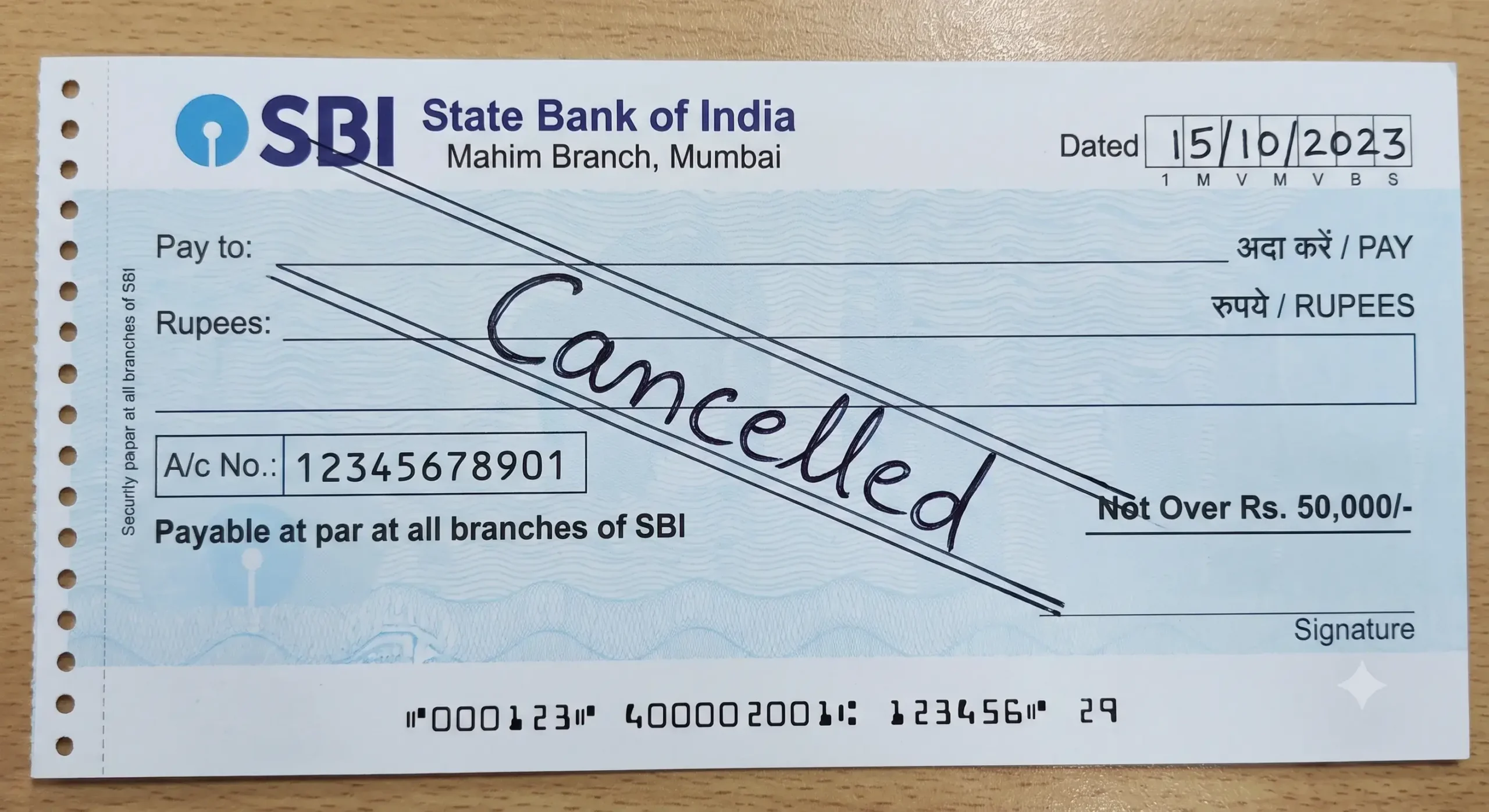
Cancelled cheque sample with dummy details. The signature box, payee, amount and date are blank.
Five Marks of a Valid Cancelled Cheque
- Two parallel lines across the face, kept clear of every printed detail
- The word CANCELLED written between the lines in ink
- Payee, amount in words and figures, and date left blank
- Signature box left blank unless the recipient asks for a signature
- A leaf from the chequebook of the same account that is being verified
Writing CANCELLED is standard practice. Not every recipient insists on the word, but it removes any doubt that the leaf is live. Readers who want to see how a filled cheque differs can read how to write the amount in words on a cheque.
On signatures, explainers from lenders such as Godrej Capital and payment firms such as Easebuzz describe a cancelled cheque as unsigned. Some institutions still ask for a signature. The safe rule is to follow the recipient’s written instruction and to sign only a leaf that is already marked cancelled.
Why a Cancel Cheque Photo Is Required
Institutions ask for a cancel cheque photo because it ties an account number to an IFSC code and, on personalised leaves, to a printed name in one document that is hard to mistype. Typical requesters are lenders setting up EMI auto-debit, brokers and mutual fund houses opening investor accounts, EPFO, insurers and employers running payroll.
| Use | What the cancelled cheque confirms | Accepted alternatives |
|---|---|---|
| Loan EMI auto-debit (physical NACH form) | Bank proof for the debit account | Recent bank statement showing account number and branch |
| Demat, trading and mutual fund KYC | Linked bank account details | Passbook or statement copy, depending on the institution |
| EPF claim and UAN bank KYC | Member name, account number and IFSC | Attested first page of the passbook if the account has no chequebook |
| Payroll and employer onboarding | Salary account details | Bank statement or passbook page, per employer policy |
| Insurance premium and claim payouts | Account for debits and settlements | Bank statement, per insurer policy |
| Income tax refund | Not required | Account is pre-validated on the e-Filing portal |
The alternatives column reflects what lender and platform guides state. Each recipient sets its own rule, so the accepted document list on the application form is the final word.
EPFO and the Cheque Leaf
EPFO’s member FAQ asks for a cancelled original cheque with the member’s name, bank account number and IFSC printed on it. If the account has no chequebook facility, the first page of the passbook, attested by the bank manager, may be enclosed instead. EPFO has since relaxed the image upload for eligible online claims where the bank KYC is verified online.
The relaxation depends on checks such as bank or NPCI verification, employer verification using a digital signature certificate, and an Aadhaar number verified by UIDAI. Claims that fail those checks can still ask for the image. The UAN member portal shows what a specific claim needs.
NACH Mandates and Loan Forms
Physical NACH mandate forms ask for bank proof, and lender guides name a cancelled cheque or a recent bank statement as the options. An American Express NACH enrolment form, for example, asks for a cancelled blank cheque or its photocopy to be attached.
E-mandates work differently. When the customer authenticates through the bank’s own page, the bank verifies the account number during the process, so an image upload is typically not part of the flow. Account details mismatches are a common cause of mandate rejection, which is why lenders still ask for proof on paper forms.
Income Tax Refunds Need No Cancelled Cheque
Income tax refunds do not run on a cancelled cheque. Taxpayers add the account on the e-Filing portal under Profile and My Bank Account, pre-validate it, and then nominate it for refund. The Income Tax Department’s user manual lists a registered e-Filing login and a valid IFSC and account number as the prerequisites. It lists no cheque upload step.
Only a validated account can be nominated to receive a refund. Taxpayers can pre-validate more than one account. Anyone who still needs to connect the PAN and the account can follow the guide on how to link PAN to a bank account.
How to Make a Cancelled Cheque in Six Steps
- Pick the right leaf. Take a leaf from the chequebook of the exact account that will be verified. After a bank merger, branch IFSC and MICR codes can change, so a leaf from an old chequebook may carry outdated codes. Compare the printed IFSC with the one the bank shows today.
- Draw two parallel lines. Run them across the blank middle of the face, from edge to edge of the payee and amount area. Keep them off the name, account number, IFSC and MICR band.
- Write CANCELLED. Use a blue or black pen and place the word between the two lines.
- Leave the fields blank. The payee, amount, date and signature box stay empty unless the recipient has asked for a signature.
- Check the printed details. Confirm that the account number, IFSC and name are fully readable after the lines are drawn.
- Photograph or scan the leaf. The next section covers how to do this so the upload is accepted.
An account holder without a chequebook can request one at the branch or through the bank’s app, or use an alternative covered later in this guide. The cheque leaf guide explains what a single leaf is and how it differs from the counterfoil.
How to Take a Cancel Cheque Photo That Gets Accepted
A cancel cheque photo is accepted when every printed detail is sharp and all four edges of the leaf are visible. Most rejections come from legibility, not from the cheque itself. A blurred IFSC, a cropped MICR band or glare over the account number can fail an automated check or a manual review.
| Do | Avoid | Why it matters |
|---|---|---|
| Place the leaf flat on a plain, dark surface | Holding it in one hand or photographing it on a patterned table | The edges must be easy to detect |
| Use daylight or an even room light | Flash directly on the leaf | Glare hides the account number and the MICR band |
| Frame all four edges and the full MICR band | Cropping the bottom strip | The band is part of what the recipient verifies |
| Capture in colour and hold the phone parallel to the leaf | Angled shots and black-and-white filters | Skewed text is harder to read |
| Check the format and size limit shown on the upload field | Compressing the file before reading the limit | Portals set their own limits, and JPG, PNG and PDF are the usual formats |
| Use a scanner app for a flat, even result | Screenshots of a photo taken earlier | Re-captured images lose sharpness |
Name mismatches cause the other common rejection. The name printed on the leaf should match the name on the KYC or application. If the bank prints the name differently from the PAN, the application may need a statement or a passbook page that shows the bank’s own record.
No Chequebook? Alternatives to a Cancelled Cheque
When an account has no chequebook, or the leaf cannot be used, the recipient may accept another document that shows the same details.
| Alternative | Where it is usually accepted | Note |
|---|---|---|
| Passbook first page attested by the bank | EPFO for accounts without chequebook; banks and lenders | Needs the bank manager’s attestation for EPFO |
| Recent bank statement | NACH forms and many KYC processes | Must show account number, name and branch details; see the guide to downloading an SBI bank statement |
| Online bank verification | Digital onboarding and e-mandates | Some platforms verify through net banking or a small test credit instead of an upload |
The practical step is to ask the recipient which proof it accepts before requesting a new chequebook. A demand draft or a cheque is a payment instrument, not an account proof, as the comparison of demand draft vs cheque explains.
Cancel Check Image vs Cancelled Cheque: Same Document, Different Spelling
“Cancel check image” and “cancel check photo” are the American spellings of the same search. In India, the instrument is spelt “cheque” and the document is called a cancelled cheque. In the United States, the matching document is usually called a voided check.
A form that asks for a cancelled cheque and a form that asks for a voided check want the same thing: a blank leaf marked void that shows the account and routing details. The spelling difference is covered in cheque vs check.
How to Share a Cancel Cheque Image Safely
A cancelled cheque still shows the account number, IFSC and name, so the image deserves the same care as any account document.
- Use official channels only. Upload through the institution’s own portal or send it to an official email address. Avoid open groups and unknown numbers.
- Never hand over a signed blank cheque as a cancelled cheque. A signed leaf without the lines and the word CANCELLED is a live instrument. See the guide on a dishonoured cheque for what happens when a live cheque goes wrong.
- Add a purpose line where allowed. A text watermark such as the recipient’s name and the date, placed outside the printed details, makes reuse harder.
- Delete stray copies. Remove the photo from shared devices and chat apps after the upload is confirmed.
- Watch the account afterwards. A quick look at the statement or balance catches unexpected debits early; the guide on checking bank balance online shows how.
What Experts Say
Practitioners who handle KYC and loan onboarding describe the same pattern. Cancelled cheque uploads fail far more often on legibility than on validity, and the usual causes are glare, a cropped MICR band and lines drawn through the account number.
Another recurring point is that applicants send a signed blank leaf when the form only asked for a cancelled one. Reviewers advise sending exactly what the form lists, and nothing more.
A third observation concerns old chequebooks. After branch or bank changes, a leaf with outdated codes is a frequent reason for a mandate or claim to bounce back, so a recent leaf with current codes saves a second submission.
Frequently Asked Questions
Is a cancel cheque photo valid for KYC?
A clear photo or scan is accepted by most institutions, but each sets its own rule. Some ask for the original leaf or a self-attested copy. The document list on the application form decides what is valid for that process.
Does a cancelled cheque need a signature?
A standard cancelled cheque carries no signature, according to explainers from Godrej Capital and Easebuzz. Some institutions still ask for one. Follow the recipient’s written instruction and sign only a leaf already marked cancelled.
Can a cancelled cheque be misused?
A leaf with two lines and the word CANCELLED is not meant for payment, but it still shows the account number, IFSC and name. Share the image only through official portals, add a purpose line where allowed, and never send a signed blank cheque in its place.
How long is a cancelled cheque valid?
Lender explainers, such as Godrej Capital’s, state that there is no set expiry for a cancelled cheque used for verification. A recent leaf with the bank’s current IFSC is the safer choice, because old leaves can carry outdated codes.
Can a bank statement or passbook replace a cancelled cheque?
Often yes, depending on the recipient. Lender and platform guides list a recent bank statement or a passbook page as alternatives. EPFO accepts an attested passbook first page when the account has no chequebook facility.
Is a cancelled cheque needed for an income tax refund?
No. The Income Tax Department’s e-Filing portal asks taxpayers to add the bank account under My Bank Account, pre-validate it and nominate it for refund. Its user manual lists a valid IFSC and account number as prerequisites.
What if the account holder’s name is not printed on the cheque?
EPFO asks for the member’s name, account number and IFSC printed on the cheque. If the name is missing, the attested first page of the passbook is the usual substitute, or the account holder can ask the bank for a personalised chequebook.