
Quick answer: A self cheque is a cheque you write to yourself to withdraw cash from your own account at your bank branch. Write “Self” in the Pay line, fill the date, amount in words and figures, and sign as per your bank records. Do not cross it. Present it at the cash counter and the cashier pays you over the counter, usually within minutes.
What Is a Self Cheque?
A self cheque is a cheque where the account holder is both the drawer and the payee. Instead of a third party’s name, you write “Self” in the Pay line, which tells the bank you are withdrawing your own money. It is not sent through clearing: the branch pays it in cash on the spot after checking your signature and balance.
In the language of the Negotiable Instruments Act, 1881, every cheque has a drawer, drawee and payee. On a self cheque:
- Drawer: you, the account holder who signs the cheque
- Drawee: your bank, which pays the money
- Payee: also you, shown by the word “Self”
If you are new to cheques, the complete guide to what a cheque is covers the basic parts of a cheque leaf.
Self Cheque vs Withdrawal Slip vs ATM
A self cheque is one of three common ways to take cash out of a savings or current account. The right choice depends on the amount, the branch you visit and whether you have your chequebook or passbook with you.
| Method | What you need | Typical use | Key limitation |
|---|---|---|---|
| Self cheque | Chequebook, valid signature | Larger cash amounts at any branch of your bank | Bank-set limits at non-home branches |
| Withdrawal slip | Passbook (usually), signature | Small withdrawals at home branch | Many banks restrict slips at non-home branches |
| ATM / debit card | Card and PIN | Small daily cash needs | Daily ATM limit set by your card variant |
For account-level caps on deposits and withdrawals, see our guide to savings account deposit and withdrawal limits.
How to Fill a Cheque for Self Withdrawal: Step by Step
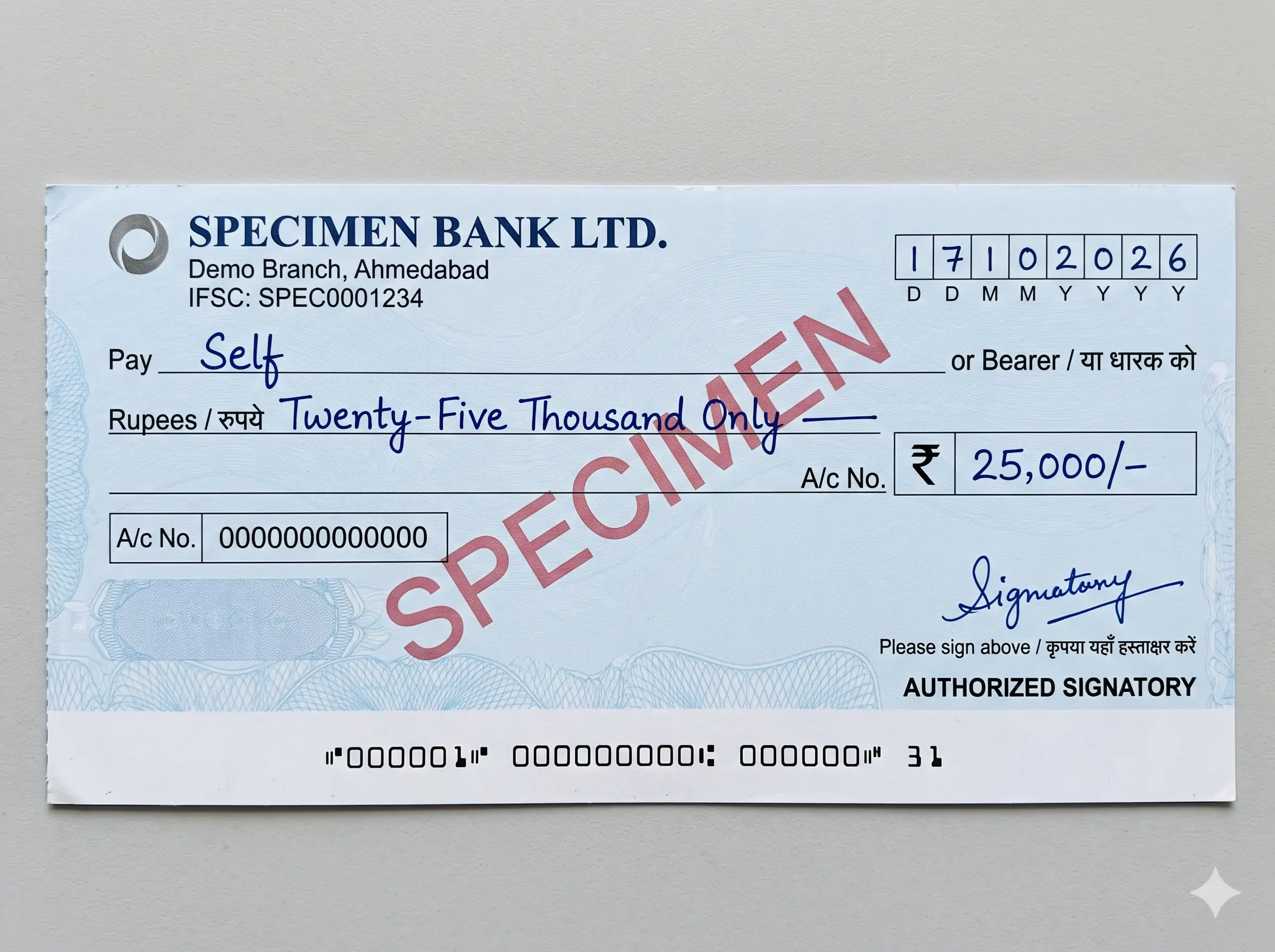
To fill a cheque for self withdrawal, write the date, write “Self” in the Pay line, write the amount in words and in figures, and sign in the signature box exactly as per your bank records. Leave the cheque uncrossed. Most branches also ask you to sign on the back of the cheque at the counter as a receipt for the cash.
Use a fresh leaf, a ball-point or gel pen with dark ink, and keep every entry inside its printed box. Here is each field in order.
Step 1: Write the Date
Fill the date in the DD MM YYYY boxes at the top right. Use the date you will present the cheque.
- Example: 1 7 1 0 2 0 2 6 for 17 October 2026
- A cheque is valid for 3 months from the date written on it, as per the Reserve Bank of India (RBI) rule in force since April 2012
- Do not write a future date if you need the cash today; the bank will not pay a post-dated cheque before its date
Step 2: Write “Self” in the Pay Line
On the line that starts with “Pay”, write Self. Start close to the left edge and draw a line through the unused space after it so nothing can be added.
- Correct: Pay Self __________ (a single horizontal stroke to fill the gap)
- Some banks also accept your own full name, but “Self” is the standard and avoids confusion at the counter
Step 3: Write the Amount in Words
Write the amount in the “Rupees” line in Indian numbering words and end with “Only”.
- Example: Rupees Twenty-Five Thousand Only
- Use lakh and crore, not million: Rupees One Lakh Fifty Thousand Only
- Start immediately after the printed “Rupees” so no words can be inserted before your entry
Our guide on how to write the amount in words on a cheque has a full conversion table and common mistakes.
Step 4: Write the Amount in Figures
In the box with the ₹ symbol, write the same amount in numbers, starting right next to the symbol, and close it with “/-“.
- Example: ₹ 25,000/-
- The words and figures must match exactly; a mismatch is one of the most common reasons a branch refuses a self cheque
Step 5: Decide on “Or Bearer”
Most cheque leaves print “or Bearer” at the end of the Pay line. For a self cheque you present in person, you can leave it as is. Striking it out turns the cheque into an order cheque payable only to you.
| Option | What it means | When to choose it |
|---|---|---|
| Leave “or Bearer” intact | Whoever presents the cheque can be paid | You are going to the branch yourself, right away |
| Strike out “or Bearer” | Only the drawer (you) can encash it, with ID | You are carrying the cheque around or there is any risk of losing it |
If someone else will collect the cash for you, do not write “Self”. Write their name in the Pay line instead and keep “or Bearer”. The bank then treats it as a third-party cash withdrawal, which usually has a lower limit and needs the collector’s ID.
Step 6: Sign the Cheque
Sign in the box at the bottom right, above “Please sign above”. The signature must match the specimen signature your bank has on record.
- Joint accounts: follow the mode of operation. “Either or survivor” accounts need one signature; “jointly” accounts need all holders to sign
- Company or partnership current accounts: the authorised signatories sign, often with the company stamp
Step 7: Sign on the Back at the Counter
When you hand the cheque to the cashier, you are usually asked to sign on the reverse. This works as your acknowledgement that you received the cash. Some branches also ask for your mobile number or a denomination preference on the back.
Step 8: Do Not Cross the Cheque
Never draw two parallel lines or write “A/c Payee” on a self cheque. Under Sections 123 to 126 of the Negotiable Instruments Act, 1881, a crossed cheque can only be paid into a bank account, not in cash over the counter. A crossed self cheque defeats its own purpose.
Sample Filled Self Cheque
Below is how a correctly filled self cheque for ₹25,000 looks, field by field.
| Field on cheque | What to write |
|---|---|
| Date | 17 10 2026 |
| Pay | Self (line drawn through remaining space) |
| Rupees (in words) | Twenty-Five Thousand Only |
| ₹ (in figures) | 25,000/- |
| Or Bearer | Leave as printed (or strike out if carrying it) |
| Crossing | None |
| Signature (front) | As per bank records |
| Signature (back) | At the cash counter, when asked |
The MICR band at the bottom (cheque number, bank sort code, and in some formats your account number) is printed by the bank. Do not write or stamp anything over it. If you are unsure what each number means, read where the account number is on a cheque.
How Self Cheque Withdrawal Works at the Branch
A self cheque withdrawal is paid at the cash counter of your bank, not through clearing. The cashier verifies the signature, checks your balance and pays the cash, usually the same day within minutes. At your home branch the process is fastest; at other branches of the same bank, extra checks and lower limits may apply.
Here is the usual sequence at the counter:
- Hand over the filled and signed cheque at the cash counter
- The cashier checks the date, amount, words versus figures, and that nothing is altered
- The signature is matched against the specimen in the core banking system
- Your available balance is confirmed
- For larger amounts, an officer may approve the payment and ask for ID
- You sign on the back of the cheque
- The cashier counts and hands over the cash, often with a token number for amounts above a branch threshold
Can You Cash a Self Cheque at Any Branch?
Yes, in most banks you can encash a self cheque at any branch of the same bank, thanks to core banking. You cannot cash it at a different bank. Banks set separate limits for “non-home” branches.
For example, State Bank of India publicly raised its non-home self cheque limit to ₹1 lakh per day in May 2021 as a temporary measure during the pandemic. Current limits vary by bank and account type, so confirm with your branch before visiting with a large amount.
Is There a Limit on Self Cheque Withdrawal?
There is no RBI-mandated rupee cap on how much you can withdraw from your own account with a self cheque at your home branch. The real limits come from three places:
- Your account balance (plus any overdraft sanctioned)
- Bank-set branch limits, especially at non-home branches and for third-party bearer cheques
- Branch cash availability, which is why banks often ask for a day’s advance notice for large withdrawals
| Scenario | Who sets the limit | What to expect |
|---|---|---|
| Self cheque at home branch | Your balance and branch cash position | Large amounts usually allowed; advance notice for very large sums |
| Self cheque at non-home branch | Your bank’s internal policy | Lower daily cap; varies by bank |
| Bearer cheque collected by someone else | Your bank’s internal policy | Lower cap than self; collector’s ID needed |
Tax Rules on Cash Withdrawal by Self Cheque (2026)
Cash withdrawals by self cheque are not taxable income, but two income tax rules apply once the yearly totals get large. From 1 April 2026, both rules sit under the Income-tax Act, 2025 and the Income-tax Rules, 2026, which replaced the 1961 Act and the 1962 Rules.
TDS on Large Cash Withdrawals: Section 393(3), Table Sl. No. 5
Banks, co-operative banks and post offices must deduct TDS at 2% once your aggregate cash withdrawals in a tax year cross ₹1 crore. The threshold is ₹3 crore for co-operative societies. This provision was Section 194N under the Income Tax Act, 1961.
| Point | Rule under the Income-tax Act, 2025 |
|---|---|
| Provision | Section 393(3), Table Sl. No. 5 (earlier Section 194N) |
| Who deducts | Banking company, co-operative bank, post office |
| Threshold | ₹1 crore per tax year (₹3 crore if the recipient is a co-operative society) |
| Rate | 2% |
| Base | Entire amount, once the threshold is exceeded (Section 393(3)(a)) |
| Not covered | Payments to the Government, banks, business correspondents and white-label ATM operators |
TDS deducted here is not an extra tax. It shows as a credit in your tax records and is adjusted against your final tax liability when you file your return. You can track it using our guide to check the TDS amount online.
PAN Requirement for Large Cash Withdrawals
Under Rule 159 of the Income-tax Rules, 2026, you must quote your PAN when your cash withdrawals from one or more accounts with a bank, co-operative bank or post office aggregate to ₹10 lakh or more in a financial year. Under the old rules, this annual trigger was ₹20 lakh.
In practice, banks already hold your PAN if it is linked to your account. If it is not, link it before your withdrawals add up. See how to link PAN to a bank account.
Common Self Cheque Mistakes That Lead to Rejection
Most refused self cheques fail on small, avoidable errors. The cashier will return the cheque without paying if any of these appear. The fix in nearly every case is to write a fresh leaf rather than correct the old one.
| Mistake | Why it is rejected | What to do |
|---|---|---|
| Words and figures do not match | Bank cannot tell which amount you meant | Write a fresh cheque |
| Overwriting or correction in amount or payee | RBI guidance since 2010 discourages any change other than the date | Use a new leaf; do not countersign corrections |
| Signature mismatch | Fails specimen verification | Sign as per bank records; update specimen if your signature has changed |
| Cheque crossed or “A/c Payee” written | Crossed cheques cannot be paid in cash | Use a new, uncrossed leaf |
| Stale cheque (older than 3 months) | Validity has lapsed | Write a fresh cheque with the current date |
| Post-dated cheque presented early | Payment date has not arrived | Wait for the date or write a new cheque |
| Insufficient balance | Funds not available | Check balance first; see how to check bank balance online |
| Damaged or torn cheque leaf | Cannot be verified or scanned | Use a fresh leaf |
Can You Correct a Mistake on a Self Cheque?
Do not correct it. The RBI circular of 22 February 2010 on CTS-2010 standard cheques states that no changes should be made on cheques except for date validation, and that a fresh cheque form should be used for any change in payee name or amount. That rule formally targets cheques cleared through the Cheque Truncation System, but most bank branches apply the same caution at the cash counter. If you make a mistake, write “CANCELLED” across the leaf and start again. Our guide on the cancelled cheque explains how to cancel a leaf properly.
Self Cheque vs Bearer Cheque vs Order Cheque
A self cheque, bearer cheque and order cheque differ in who can collect the money. A self cheque pays the account holder in cash. A bearer cheque pays whoever presents it. An order cheque pays only the named person or their endorsee. A crossed cheque, of any kind, can only be deposited to a bank account.
| Type | Pay line | “Or Bearer” | Who gets paid | Cash at counter? |
|---|---|---|---|---|
| Self cheque | Self | Usually left intact | Account holder | Yes |
| Bearer cheque | A named person | Intact | Anyone holding it | Yes, within bank limits |
| Order cheque | A named person | Struck out | Named person only, with ID | Yes, after ID check |
| Crossed / A/c Payee | A named person | Either | Credited to payee’s account | No |
For a detailed comparison of the two non-self types, including safety and when to use each, read our guide on bearer cheque vs order cheque.
If you want to move money into someone else’s account rather than take cash, a crossed cheque, NEFT, IMPS or UPI is safer. For a guaranteed instrument, compare demand draft vs cheque.
Safety Tips for Using Self Cheques
A self cheque is close to cash: if it is lost while “or Bearer” is intact, anyone can try to encash it. Follow these habits to protect the money in your account.
- Fill it at the branch, not at home, if you are carrying it any distance
- Strike out “or Bearer” if there is any chance the cheque could be lost before you reach the counter
- Never sign a blank cheque, even “just in case”
- Draw a line after “Self” and after the amount in words so nothing can be added
- Record the cheque number, date and amount on the counterfoil or in your phone
- Use Positive Pay where your bank offers it. Under the RBI’s Positive Pay System, you share key cheque details with your bank in advance for high-value cheques. Whether it applies to self cheques encashed at the counter varies by bank, so ask your branch
- Report a lost cheque immediately and request a stop payment through net banking, the mobile app or the branch
Want to understand the parts of a leaf in more detail? Read our explainer on cheque leaf meaning.
When a Self Cheque Is the Right Choice
A self cheque is the best option when you need more cash than your ATM card allows in a day, when you do not have your passbook, or when you are at a branch other than your home branch. For small amounts, an ATM is quicker; for transfers to another person, use a digital mode.
Typical situations where Indian account holders use self cheques:
- Paying staff wages in cash for a small business or shop
- Withdrawing a large amount for a wedding, medical bill or property token payment
- Taking cash from a current account where no debit card is issued
- Withdrawing at a non-home branch where withdrawal slips are not accepted
What Experts Say
Bank branch staff and practitioners who handle counter withdrawals tend to make the same points:
- Most refused self cheques are rejected for words-and-figures mismatches or overwriting, not for balance issues.
- Giving the branch a day’s notice for a withdrawal of several lakh rupees avoids a “cash not available” wait, especially at smaller branches.
- Account holders who withdraw large sums regularly should track their yearly total, because the PAN quoting trigger and the TDS threshold are based on aggregate withdrawals, not single transactions.
- Keeping your specimen signature updated with the bank prevents repeated signature-mismatch refusals, particularly for senior citizens whose signatures change over time.
Frequently Asked Questions
How do I fill a cheque for self withdrawal?
Write the date, write “Self” in the Pay line, write the amount in words ending with “Only”, write the same amount in figures next to the ₹ symbol, and sign as per your bank records. Do not cross the cheque. Present it at your bank’s cash counter and sign on the back when asked.
Can I withdraw cash from any branch using a self cheque?
Yes, most banks allow self cheque withdrawal at any branch of the same bank through core banking. Non-home branches usually apply a lower daily limit set by the bank. You cannot encash your self cheque at a different bank.
Is there a maximum limit for self cheque withdrawal?
RBI does not set a fixed rupee cap on self cheque withdrawal from your own account. The limit depends on your available balance, your bank’s internal rules for home and non-home branches, and the branch’s cash position. Banks may ask for advance notice for very large amounts.
Should I strike out “or Bearer” on a self cheque?
You can leave “or Bearer” intact if you are presenting the cheque yourself straight away. Strike it out if you are carrying the cheque around, because an order cheque can only be paid to you after ID verification.
Can someone else withdraw cash using my self cheque?
Not if it says “Self”. If you want another person to collect cash, write their name in the Pay line instead of “Self” and keep “or Bearer”. The bank will treat it as a third-party withdrawal, which usually has a lower limit and requires the collector’s ID.
Is TDS deducted on self cheque withdrawal?
TDS at 2% applies only when your aggregate cash withdrawals in a tax year exceed ₹1 crore (₹3 crore for co-operative societies), under Section 393(3), Table Sl. No. 5 of the Income-tax Act, 2025. Below that level, no TDS is deducted on self cheque withdrawals.
Do I need PAN to withdraw cash with a self cheque?
Under Rule 159 of the Income-tax Rules, 2026, PAN must be quoted when your cash withdrawals aggregate to ₹10 lakh or more in a financial year. Most banks already hold your PAN if it is linked to your account.
How long is a self cheque valid?
A self cheque is valid for 3 months from the date written on it, as per the RBI rule in force since April 2012. After that, the bank will not pay it and you need to write a fresh cheque.
What happens if I make a mistake while writing a self cheque?
Do not overwrite or correct it. Write “CANCELLED” across the leaf and use a fresh cheque. RBI guidance on CTS-2010 cheques advises against any change other than the date, and most branches refuse altered cheques at the counter.
Can I cross a self cheque?
No. A crossed cheque can only be paid into a bank account under Sections 123 to 126 of the Negotiable Instruments Act, 1881. If you cross a self cheque, the branch cannot pay you cash over the counter.
This article is for general information only and is not financial, legal or tax advice. Bank-specific withdrawal limits and procedures change; confirm with your bank before withdrawing large amounts. Last updated: 17 October 2026.