
Quick answer: To fill a bank deposit slip, write the date, branch, account number and account holder name, then enter the amount. On a cash deposit slip, list the number of notes of each denomination. On a cheque deposit slip, write the cheque number, cheque date, drawee bank and amount. Write the total in words, sign, and fill the counterfoil with the same details.
| Slip type | Extra section you fill | What you hand in |
|---|---|---|
| Cash deposit slip | Denomination table (notes x count) | Slip + cash |
| Cheque deposit slip | Cheque number, date, drawee bank and branch | Slip + cheque |
| Demand draft deposit | Same as cheque (DD number, issuing bank) | Slip + DD |
What Is a Deposit Slip?
A deposit slip is a bank form, also called a pay-in slip, that tells the bank which account to credit and what you are depositing. Every Indian bank uses one for counter deposits of cash, cheques and demand drafts. The bank keeps the main slip and returns the stamped counterfoil to you as proof of deposit.
Most slips have two parts:
- Main slip (bank’s copy): Retained by the cashier or clearing desk and used to post the credit.
- Counterfoil (customer’s copy): A smaller strip on the left that the bank stamps, signs and hands back.
The counterfoil is your only paper proof that the bank received your cash or cheque. Keep it until the credit shows in your passbook or statement.
Types of bank deposit slip
| Type | Used for | Common name at the branch |
|---|---|---|
| Cash deposit slip | Notes and coins | Cash pay-in slip |
| Cheque deposit slip | Cheques and demand drafts | Cheque pay-in slip, clearing slip |
| Combined slip | Cash and cheque on one form | Deposit / Pay-in slip |
| Scheme slip | PPF, RD, SCSS, loan repayment | Scheme-specific pay-in slip |
Many banks, including Punjab & Sind Bank, Indian Overseas Bank and RBL Bank, print an instruction on the slip asking customers to use separate slips for cash, local cheques and outstation cheques. Follow that instruction even when the form looks combined.
Fields on a Bank Deposit Slip
A bank deposit slip carries the same core fields across banks, even though layouts differ. The table below covers what you will find on slips from public sector, private and cooperative banks.
| Field | What to write | Common mistake |
|---|---|---|
| Date | Date of deposit (DD/MM/YYYY) | Writing the cheque date here |
| Branch | Branch where you are depositing | Leaving it blank |
| Account type | Tick SB, CA, OD, CC, RD, TL or DL | Ticking SB for a current account |
| Account number | Full account number, digit by digit | One wrong digit sends money elsewhere |
| Name | Account holder name as per bank records | Writing the depositor’s name instead |
| Mobile number | Account holder or depositor mobile | Skipping it |
| Amount in figures | Total being deposited | Mismatch with denomination total |
| Amount in words | Same total in words, ending with “Only” | Using millions instead of lakh |
| PAN / Form 97 | PAN if the bank asks (see PAN section) | Leaving blank when the branch requires it |
| Signature | Depositor’s signature | Unsigned slip |
The account type codes stand for Savings Bank (SB), Current Account (CA), Overdraft (OD), Cash Credit (CC), Recurring Deposit (RD), Term Loan (TL) and Demand Loan (DL). Our banking abbreviations guide explains these and other short forms printed on bank forms.
How to Fill Cash Deposit Slip: Step by Step
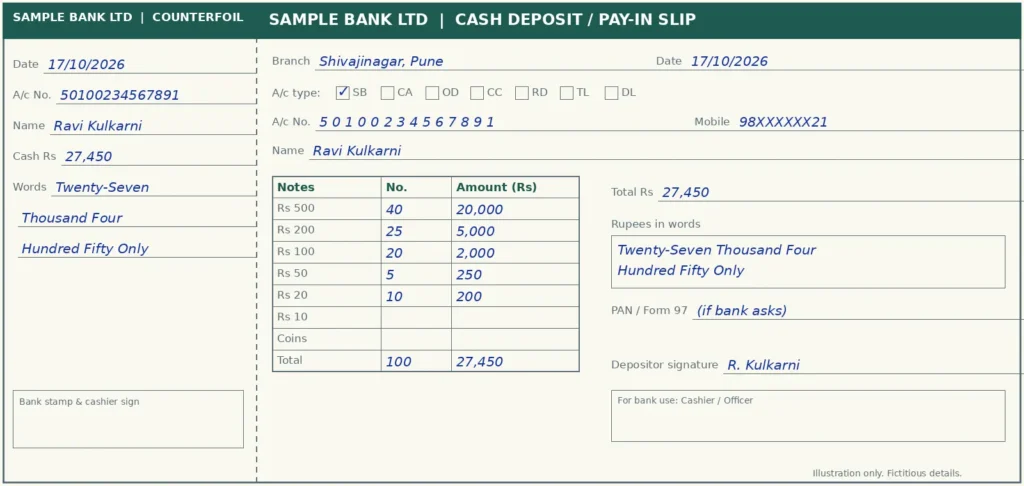
A cash deposit slip needs your account details plus a denomination breakdown that adds up to the total. Fill it in this order to avoid corrections at the counter.
Step 1: Fill the account details
Write the date, branch name, account type and account number. Copy the account number from your passbook or cheque book, not from memory. Write the account holder’s name exactly as it appears in bank records.
Step 2: Count and sort the notes
Sort notes by denomination before you write anything. Face all notes the same way. Cashiers count faster and reject fewer bundles when notes are sorted and soiled notes are kept apart.
Step 3: Fill the denomination table
Write the number of notes against each denomination, multiply, and enter the value in the amount column.
| Denomination | Number of notes | Amount (₹) |
|---|---|---|
| ₹500 | 40 | 20,000 |
| ₹200 | 25 | 5,000 |
| ₹100 | 20 | 2,000 |
| ₹50 | 5 | 250 |
| ₹20 | 10 | 200 |
| ₹10 | 0 | 0 |
| Coins | 0 | 0 |
| Total | 100 | 27,450 |
Step 4: Write the total in figures and words
Enter ₹27,450 in the total box. In words, write: Rupees Twenty-Seven Thousand Four Hundred Fifty Only. Start close to the left edge and end with “Only” so nothing can be added later. Our guide on how to write amount in words on a cheque covers the lakh and crore format in detail.
Step 5: Sign and fill the counterfoil
Sign the slip. Copy the date, account number, name and total onto the counterfoil. Hand the slip and cash to the cashier and collect the stamped counterfoil.
Can you deposit ₹2000 notes using a deposit slip?
No. Bank branches stopped accepting ₹2000 notes for deposit or exchange on October 7, 2023. The notes remain legal tender, but you can deposit them only at one of the 19 RBI Issue Offices or by sending them through India Post to an RBI Issue Office for credit to your account (RBI press release 2026-2027/190, May 1, 2026). Leave the ₹2000 row blank if your bank’s printed slip still has one.
How to Fill Cheque Deposit Slip: Step by Step
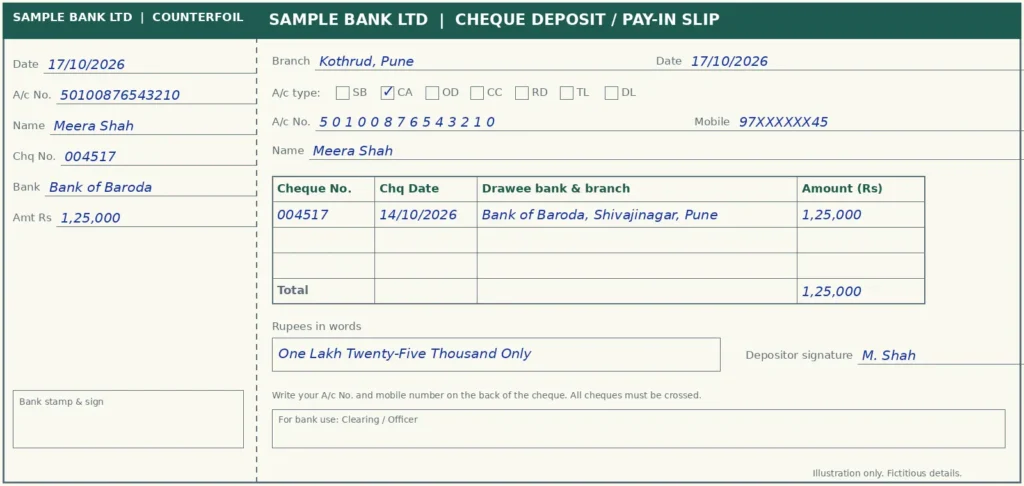
A cheque deposit slip replaces the denomination table with a cheque details section. You list each cheque by number, date, bank and amount, and the bank uses these details to match the slip with the scanned cheque in the Cheque Truncation System (CTS).
Step 1: Check the cheque first
Before you fill the slip, confirm these points on the cheque:
- Payee name matches your account name
- Date is not more than three months old (RBI/2011-12/251)
- Amount in words and figures match
- Drawer has signed, with no overwriting
If any of these fail, the cheque will come back unpaid and a fresh slip will not fix it. Read drawer, drawee and payee explained if you are unsure whose name goes where.
Step 2: Fill the account details
Write the deposit date, branch, account type, account number and name. These are the same fields as a cash deposit slip.
Step 3: Fill the cheque details section
| Column on slip | Where to find it on the cheque | Example |
|---|---|---|
| Cheque number | First 6 digits of the MICR line at the bottom | 004517 |
| Cheque date | Date box at the top right | 14/10/2026 |
| Drawee bank and branch | Printed at the top left of the cheque | Bank of Baroda, Shivajinagar, Pune |
| Amount | Amount in figures on the cheque | 1,25,000 |
The cheque leaf guide labels each part of a cheque, including the MICR band. If you are new to cheques, start with what a cheque is and how it works.
Step 4: Write the total and sign
Write the total in figures and words. For the example above: Rupees One Lakh Twenty-Five Thousand Only. Sign the slip and copy the details onto the counterfoil.
Step 5: Write your details on the back of the cheque
Write your account number, name and mobile number on the back of the cheque. Many bank slips print this instruction because it helps the bank trace a cheque that gets separated from its slip. Never write in the MICR band on the front.
For the full counter process after filling the slip, including drop box versus counter deposit, see our guide on how to deposit a cheque.
Cash Deposit Slip vs Cheque Deposit Slip
| Point | Cash deposit slip | Cheque deposit slip |
|---|---|---|
| Main extra section | Denomination table | Cheque number, date, drawee bank |
| Credit timing | Immediate, at the counter | After CTS clearing |
| Proof of deposit | Stamped counterfoil | Stamped counterfoil |
| Can it be dropped in a box? | No, cash goes to the cashier | Yes, cheque drop box allowed |
| Bank can reject for | Counterfeit or soiled notes, total mismatch | Errors on the cheque or slip |
| Multiple items on one slip | One total | Several cheques listed line by line |
Filled Deposit Slip Examples
The examples below use fictitious names and account numbers. Totals and words have been checked for each case.
Example 1: Cash deposit into your own savings account
Ravi Kulkarni deposits ₹27,450 in cash into his savings account.
- Account type: SB
- Denomination: 40 x ₹500, 25 x ₹200, 20 x ₹100, 5 x ₹50, 10 x ₹20
- Total: ₹27,450
- In words: Rupees Twenty-Seven Thousand Four Hundred Fifty Only
- PAN: Not required under the tax rules for this deposit
Example 2: Single cheque deposit
Meera Shah receives a cheque of ₹1,25,000 from a client, drawn on Bank of Baroda.
- Cheque number: 004517
- Cheque date: 14/10/2026
- Drawee bank: Bank of Baroda, Shivajinagar, Pune
- Total: ₹1,25,000
- In words: Rupees One Lakh Twenty-Five Thousand Only
If the issuer’s bank requires Positive Pay for cheques of this value, ask the client to register the cheque before you deposit it. Our Positive Pay system guide explains how it works.
Example 3: Three cheques on one slip
A small business owner deposits three customer cheques into a current account using one cheque deposit slip.
| Cheque no. | Date | Drawee bank | Amount (₹) |
|---|---|---|---|
| 112233 | 10/10/2026 | State Bank of India | 18,500 |
| 445566 | 12/10/2026 | HDFC Bank | 42,000 |
| 778899 | 15/10/2026 | Canara Bank | 9,750 |
| Total | 70,250 |
In words: Rupees Seventy Thousand Two Hundred Fifty Only. Account type: CA. List each cheque on its own line. If the slip has fewer rows than you need, use a second slip rather than squeezing entries.
Example 4: Cash deposit of ₹75,000
Anil deposits ₹75,000 in cash (150 x ₹500 notes). The printed slip at his branch says “PAN or Form 60 for cash deposit of ₹50,000 and above.” Under Rule 159 of the Income-tax Rules 2026, PAN is mandatory only when cash deposits aggregate to ₹10 lakh or more in a financial year. Anil writes his PAN on the slip anyway, because the branch asks for it under its own policy and writing it avoids a delay at the counter.
- Total: ₹75,000
- In words: Rupees Seventy-Five Thousand Only
Example 5: Depositing cash into someone else’s account
Priya deposits ₹15,000 into her father’s savings account at his bank’s branch. She writes her father’s account number and name in the account fields, and her own name, mobile number and signature in the depositor fields. Some banks restrict cash deposits by a person other than the account holder or ask for the depositor’s ID, so check with the branch first.
PAN on a Deposit Slip: 2026 Rules
PAN is mandatory on a cash deposit only when your cash deposits or withdrawals add up to ₹10 lakh or more in a financial year across one or more accounts. This threshold comes from Rule 159 of the Income-tax Rules 2026, in force from April 1, 2026.
| Rule | Before April 1, 2026 | From April 1, 2026 |
|---|---|---|
| Law | Rule 114B, Income-tax Rules 1962 | Rule 159, Income-tax Rules 2026 |
| PAN trigger for cash deposit | Above ₹50,000 in one day | ₹10 lakh or more in a financial year (aggregate) |
| Declaration if no PAN | Form 60 | Form 97 |
| Cheque deposits | No PAN trigger | No PAN trigger |
Why many slips still say ₹50,000: most bank slips were printed under the old Rule 114B, and branch stock takes time to change. Banks can also ask for PAN under their own KYC policy. In practice:
- If you have a PAN, write it on the slip for large cash deposits. It costs nothing and avoids a counter dispute.
- If you do not have a PAN and your cash deposits cross ₹10 lakh in the year, the bank will need Form 97, or it may refuse the deposit.
- Make sure your PAN is linked to your bank account. If you do not have one, you can apply for a PAN online.
For annual reporting limits, TDS on withdrawals and the ₹2 lakh cash receipt rule, see our guide on savings account deposit and withdrawal limits.
Common Mistakes on a Deposit Slip and How to Fix Them
| Mistake | What happens | Fix |
|---|---|---|
| Wrong account number | Money goes to another account or slip is rejected | Copy from passbook; recheck before signing |
| Figures and words do not match | Cashier returns the slip | Rewrite on a fresh slip |
| Denomination total does not match the cash | Counter delay | Recount before you queue |
| Overwriting on the slip | Bank may refuse it | Use a new slip instead of correcting |
| Cash and cheque on the same slip when the bank asks for separate slips | Processing delay | Use one slip per type |
| Counterfoil left blank | No usable proof of deposit | Fill it fully and get it stamped |
| Cheque details copied from the wrong cheque | Mismatch in CTS | Fill one line per cheque, in order |
A wrong account number is the costliest error. If money goes into the wrong account, inform your branch in writing at once with the counterfoil. Recovery depends on the bank tracing the credit and the other account holder’s cooperation.
Our guide on where the account number is on a cheque helps you find the right number quickly.
After You Submit the Deposit Slip
Cash is credited at the counter. A cheque goes through CTS clearing, and the credit depends on the paying bank’s confirmation.
| Item deposited | When the credit usually appears | How to confirm |
|---|---|---|
| Cash at counter | Same time, at the counter | SMS alert, passbook |
| Cheque in the CTS window | Same working day, after the paying bank confirms | SMS alert, statement |
| Cheque after branch cut-off | Next working day | SMS alert, statement |
Under RBI circular RBI/2025-26/156 (December 24, 2025), the CTS presentation session runs from 9:00 AM to 3:00 PM and the confirmation session from 9:00 AM to 7:00 PM on working days. Phase 2 of continuous clearing, which would have shortened confirmation to three hours, is postponed until further notice. Branch cut-off times are usually earlier than 3:00 PM. Read more in our guides on cheque clearing time and CTS cheques.
If the cheque comes back unpaid, the return memo states the reason. See dishonoured cheque meaning, charges and consequences for what to do next. To track the credit without visiting the branch, check your bank balance online.
Where to Get a Deposit Slip Form
You can get a deposit slip form from the slip stand at any branch of your bank, free of charge. Many banks, including Punjab & Sind Bank, Indian Overseas Bank and RBL Bank, also publish printable deposit slip PDFs on their websites, often in regional languages.
- Branch counter or slip stand: The safest option. You get the bank’s current format.
- Bank website: Look under “Downloads” or “Forms.” Print on plain A4 paper at full scale.
- Self-printed slips: Some branches accept them; others insist on their own printed stock. Ask before relying on a printout.
- Cash deposit machines: No slip needed. You enter the account number on screen and get a printed receipt.
Use the slip of the bank where the account is held. An SBI slip will not work at an HDFC Bank branch, and a cheque for your SBI account cannot be deposited at another bank’s branch.
Demand drafts use the same cheque deposit slip. For the difference between the two instruments, read demand draft vs cheque.
What Experts Say
Branch staff and chartered accountants who handle business collections tend to give the same advice on deposit slips:
- Fill slips at home or at your desk, not in the queue. Most counter rejections come from rushed slips with mismatched totals.
- For business accounts, record the cheque number and drawer name from the slip in your books on the day of deposit. Reconciliation and any cheque bounce notice become far easier.
- Keep counterfoils in date order for at least the current financial year. They are the first document a branch asks for when a credit goes missing.
- Write PAN on large cash slips even when the tax rules do not demand it. Arguing the Rule 159 threshold at a busy counter rarely saves time.
Frequently Asked Questions
How do I fill a deposit slip for cash?
Write the date, branch, account type, account number and account holder name. List the number of notes for each denomination, multiply, and add the values. Write the total in figures and words, sign the slip, and fill the counterfoil with the same details.
How do I fill a cheque deposit slip?
Write the date, branch, account number and name. In the cheque section, enter the cheque number, cheque date, drawee bank and branch, and amount. Write the total in figures and words, sign the slip, and write your account number and mobile number on the back of the cheque.
Is PAN required on a deposit slip in 2026?
Under Rule 159 of the Income-tax Rules 2026, PAN is mandatory when cash deposits or withdrawals aggregate to ₹10 lakh or more in a financial year. Cheque deposits do not trigger PAN. Many printed slips still mention ₹50,000, and banks may ask for PAN under their own policy.
Can I use one deposit slip for cash and cheques?
Most banks ask for separate slips for cash and cheques, and some also separate local and outstation cheques. Using one slip for both can delay processing. Follow the instruction printed on your bank’s slip.
Can I deposit multiple cheques with one slip?
Yes. List each cheque on a separate line with its number, date, drawee bank and amount, then write the combined total. If the slip runs out of rows, use a second slip.
What is the counterfoil on a deposit slip?
The counterfoil is the customer’s copy of the deposit slip. The bank stamps and signs it and returns it to you. It is your proof that the bank received your cash or cheque, so keep it until the credit appears in your account.
Can someone else deposit money into my account?
Yes. Anyone can deposit a cheque in your name by writing your account number and name on the slip. For cash deposits by someone other than the account holder, some banks ask for the depositor’s ID or restrict the deposit, so check with the branch.
Sources: Income-tax Rules 2026 (Rule 159; Forms 97 and 98), Income-tax Rules 1962 (Rule 114B); Reserve Bank of India circulars RBI/2025-26/156 (December 24, 2025), RBI/2025-26/73 (August 13, 2025), RBI/2011-12/251 and RBI/2006-07/214; RBI press release 2026-2027/190 (May 1, 2026) on ₹2000 banknotes; deposit slip formats published by Punjab & Sind Bank, Indian Overseas Bank and RBL Bank. Information current as of October 2026. Slip layouts, cut-off times and third-party deposit policies vary by bank, so confirm with your branch.