
A crossed cheque is a cheque marked with two parallel lines, usually across the top left corner, that tells the bank not to pay cash over the counter. The money can only be credited to a bank account. Crossing is governed by Sections 123 to 131A of the Negotiable Instruments Act, 1881, and it is the simplest way to protect a cheque from theft or misuse.
What Is a Crossed Cheque? (Cross Cheque Meaning)
A crossed cheque is a cheque that can be paid only through a bank, not in cash. The crossing (two parallel transverse lines, with or without words between them) is an instruction to the paying bank under the Negotiable Instruments Act, 1881. For example, a ₹45,000 rent cheque with two lines drawn on it must be deposited into the landlord’s account; the landlord cannot walk up to the counter and collect cash.
Quick facts:
- Governing law: Chapter XIV of the Negotiable Instruments Act, 1881 (Sections 123 to 131A)
- Main effect: No cash payment at the counter; funds move bank to bank
- Who benefits: The drawer (the person writing the cheque) and the payee, because a lost or stolen crossed cheque leaves an audit trail through a bank account
- Applies to drafts too: Section 131A extends the crossing rules to bank drafts
If you are new to the parts of a cheque, start with what a cheque is and who the drawer, drawee and payee are.
Crossed Cheque vs Open Cheque
An open (uncrossed) cheque can be encashed at the drawee bank’s counter. A crossed cheque cannot. That single difference is the reason crossing exists.
| Feature | Open (uncrossed) cheque | Crossed cheque |
|---|---|---|
| Cash at counter | Yes | No |
| Paid into bank account | Yes | Yes, only route |
| Risk if lost or stolen | High, anyone can encash a bearer cheque | Low, funds land in a traceable account |
| Typical use | Self withdrawal, small payments | Rent, vendor payments, loans, fees |
| Legal basis | General NI Act rules | NI Act Sections 123 to 131A |
A cheque written to “Self” is normally left open so you can withdraw cash yourself. See our guide to the self cheque for how that works. Crossing also interacts with how a cheque is made out, covered in bearer cheque vs order cheque.
Cross Cheque Image: Where the Crossing Goes
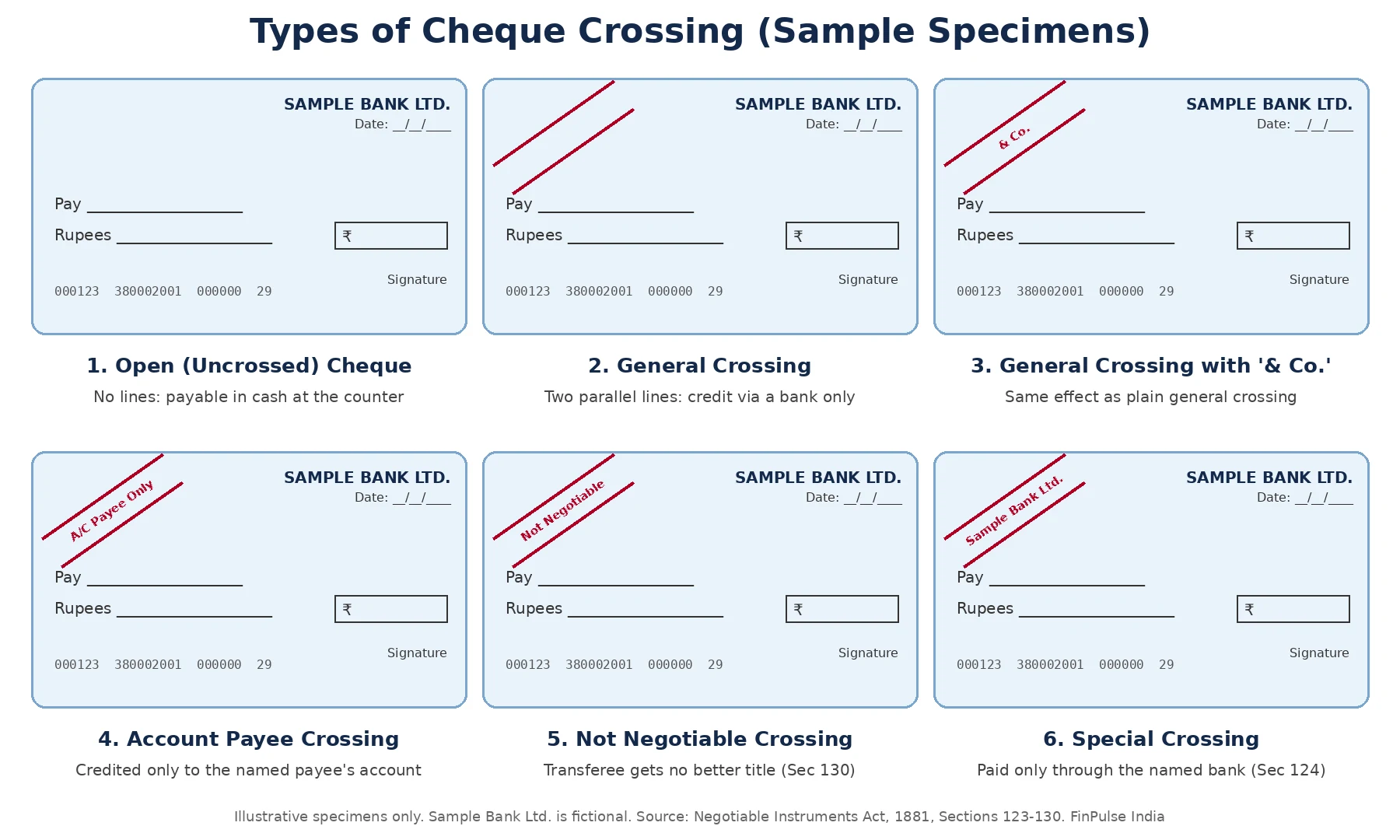
The crossing is drawn as two parallel slanting lines across the face of the cheque, almost always in the top left corner. The image above shows six specimens side by side, from an open cheque to a special crossing.
Practical points from the specimens:
- Position: Top left corner is the convention. It keeps the crossing away from the payee name, amount and signature, so nothing important is obscured.
- Lines: Two parallel lines are enough for a general crossing. They do not need to be ruled perfectly.
- Words: Anything written between the lines (“& Co.”, “A/C Payee Only”, “Not Negotiable” or a bank’s name) changes the type of crossing.
- Ink: Use the same pen as the rest of the cheque. Bank staff treat a crossing in different ink as a possible alteration.
A crossing is not the same as cancelling a cheque. A cancelled cheque has “CANCELLED” written across it and cannot be used for payment at all. See the cancelled cheque image guide for that format.
Types of Crossing Cheque
There are two statutory types of crossing in the Negotiable Instruments Act: general crossing (Section 123) and special crossing (Section 124). Banks and textbooks also recognise restrictive variants built on top of these, mainly “not negotiable” crossing (Section 130) and account payee crossing (banking practice and RBI instructions).
| Type | How it looks | Legal source | Effect |
|---|---|---|---|
| General crossing | Two parallel lines, blank | Section 123 | Paid only to a banker, into any account |
| General crossing with “& Co.” | Two lines with “& Co.” between them | Section 123 | Same as plain general crossing |
| Special crossing | Name of a bank across the face | Section 124 | Paid only to the named bank or its collection agent |
| Not negotiable crossing | “Not Negotiable” within a general or special crossing | Section 130 | Transferee gets no better title than the transferor |
| Account payee crossing | “A/C Payee” or “A/C Payee Only” within the crossing | Banking practice, RBI circulars | Credited only to the named payee’s account |
| Double crossing | Specially crossed to a second bank | Section 127 | Refused unless the second bank is a collection agent |
1. General Crossing (Section 123)
General crossing means the cheque bears two parallel transverse lines across its face, with or without the words “and company” (or “& Co.”) or “not negotiable”. Under Section 126, the bank on which it is drawn can pay it only to another banker. In practice, the payee deposits it into any bank account, and the funds arrive through clearing.
The words “& Co.” have no legal meaning of their own. They are a historical habit and carry the same effect as two blank lines.
2. Special Crossing Cheque (Section 124)
A special crossing cheque is one that bears the name of a specific bank across its face, with or without the words “not negotiable”. Section 126 then requires the paying bank to pay it only to the bank named in the crossing, or to that bank’s agent for collection. For example, a cheque crossed “HDFC Bank Ltd.” can be collected only through HDFC Bank.
Points worth knowing about special crossing:
- Lines are optional in law. Section 124 only requires the banker’s name. Most people still draw two lines around the name, as in the image above.
- It is stricter than general crossing. A general crossing allows any bank; a special crossing allows one.
- It cannot be downgraded. Section 125 lets a holder turn a general crossing into a special one, but there is no provision to turn a special crossing back into a general one.
- Use case: Businesses use it when they want payments routed only through their main banker, which simplifies reconciliation.
3. Not Negotiable Crossing (Section 130)
A “not negotiable” crossing adds those words inside a general or special crossing. Under Section 130, anyone taking such a cheque cannot get, and cannot pass on, a better title than the person who gave it to them.
The common misreading is that “not negotiable” means “not transferable”. It does not. The cheque can still be transferred, but the transferee carries the risk of any defect in the earlier holder’s title. If a thief transfers a “not negotiable” cheque to an innocent buyer, the buyer gets nothing, because the thief had nothing.
4. Account Payee Crossing
Account payee crossing adds “A/C Payee” or “A/C Payee Only” between the crossing lines. It means the amount should be credited only to the account of the payee named on the cheque.
This crossing is not defined in the Negotiable Instruments Act. Its force comes from banking practice and the Reserve Bank of India, which has repeatedly instructed banks not to credit account payee cheques to any person other than the named payee (for example, RBI circular DBOD.BP.BC.No.32/21.01.001/2009-10 dated August 27, 2009). The only notable relaxation lets banks collect account payee cheques of up to ₹50,000 for members of co-operative credit societies, subject to written undertakings and KYC (RBI circular dated October 1, 2010).
Account payee crossing is the safest and most widely used form today. It is also the form the Income-tax Act refers to when it requires an “account payee cheque” (covered below).
5. Double Crossing (Section 127)
Double crossing happens when a cheque already crossed specially to one bank is crossed specially again to a second bank. Section 127 says the paying bank must refuse such a cheque, unless the second crossing is to an agent of the first bank for collection. Section 125 allows exactly that: the bank named in a special crossing may cross it again to its collecting agent, typically when it has no branch in the paying bank’s clearing area.
Who Can Cross a Cheque?
The drawer usually crosses the cheque while writing it, but Section 125 of the NI Act also lets others add or strengthen a crossing after issue:
| Person | What they can do (Section 125) |
|---|---|
| Drawer | Cross the cheque generally or specially when issuing it |
| Holder | Cross an uncrossed cheque generally or specially |
| Holder | Convert a general crossing into a special crossing |
| Holder | Add “not negotiable” to a general or special crossing |
| Banker named in a special crossing | Cross it specially again to its agent for collection |
Notice the direction: every permitted change makes the cheque safer. The Act gives no one a right to remove or weaken a crossing.
Can a Crossing Be Cancelled?
The NI Act has no provision for cancelling a crossing. Some banks have historically accepted a drawer writing “crossing cancelled, pay cash” with a full signature, but this is bank practice, not law, and many banks now refuse it. If you need cash, the cleaner route is to issue a fresh open cheque. Confirm with your branch before relying on an “opened” crossing.
How to Cross a Cheque: Step by Step
- Fill in the cheque first. Date, payee name, amount in figures and words. Our guide on writing the amount in words covers the formats banks accept.
- Draw two parallel lines diagonally across the top left corner, about 2 to 3 cm long.
- Add words if needed. Write “A/C Payee Only” for most payments to individuals and businesses. Write a bank’s name for a special crossing.
- Sign the cheque in the signature box as usual. No separate signature is needed for the crossing.
- Register high-value cheques under Positive Pay if your bank requires it. Under RBI’s framework, banks may make confirmation mandatory for cheques of ₹5 lakh and above. See our Positive Pay System guide.
The payee then deposits it like any other cheque. See how to deposit a cheque and cheque clearing time for what happens next.
Why Crossing a Cheque Matters
Crossing matters because it turns a piece of paper anyone could encash into a payment that must pass through a bank account. That protects the drawer, the payee and the banks involved.
Protection Against Theft and Fraud
A stolen open bearer cheque can be cashed at the counter within minutes. A crossed cheque must be deposited into an account, and an account payee cheque must be deposited into the payee’s own account. Every deposit leaves a KYC-verified trail, which makes fraud harder and recovery more likely.
Legal Protection for Banks
The NI Act ties bank liability to the crossing:
- Paying bank (Section 128): If it pays a crossed cheque “in due course”, it is treated as having paid the true owner.
- Paying bank (Section 129): If it pays a crossed cheque in breach of the crossing, for example in cash, it is liable to the true owner for the loss.
- Collecting bank (Section 131): It is not liable to the true owner if it collected the cheque for a customer in good faith and without negligence, even if the customer’s title turns out to be defective. Since the cheque truncation amendments, this includes a duty to check the electronic image of a CTS cheque for apparent forgery or tampering.
Income-tax Rules Require Account Payee Instruments
Several cash-limit rules accept only an account payee cheque, account payee draft or electronic transfer. From April 1, 2026, these sit in the Income-tax Act, 2025:
| Rule | Income-tax Act, 2025 | Earlier section (1961 Act) | Threshold |
|---|---|---|---|
| Accepting loans, deposits or specified sums | Section 185 | Section 269SS | ₹20,000 or more |
| Receiving any amount in a day, single transaction or one event | Section 186 | Section 269ST | ₹2,00,000 or more |
A plain crossed cheque without “A/C Payee” does not meet these requirements. If you are lending to a relative, taking an advance on property or accepting a large business receipt by cheque, mark it account payee.
Crossed Cheque vs Demand Draft
Both are crossed in the same way, because Section 131A applies the crossing chapter to bank drafts. The difference is who guarantees payment.
| Point | Crossed cheque | Crossed demand draft |
|---|---|---|
| Issued by | Account holder | Bank |
| Can it bounce? | Yes, if funds are short | No, prepaid |
| Crossing rules | NI Act Sections 123 to 131 | Same, via Section 131A |
| Common use | Rent, vendors, personal payments | Admissions, deposits, government fees |
For a fuller comparison, see demand draft vs cheque.
Common Mistakes With Crossed Cheques
- Assuming crossing stops a bounce. It does not. A crossed cheque with insufficient funds is dishonoured like any other. See cheque bounce and the Section 138 cheque bounce case process.
- Writing “A/C Payee” outside the lines. Keep the words inside the crossing so the bank reads it as part of the crossing.
- Crossing a self cheque. You will not be able to withdraw cash with it. Leave a self cheque open.
- Leaving “or bearer” intact on an account payee cheque. It creates ambiguity. Strike out “or bearer” when you add A/C Payee.
- Crossing a post-dated cheque and forgetting the date rules. Crossing does not change the three-month validity from the cheque date. See post-dated cheque.
What Experts Say
Bank operations staff and practising chartered accountants generally give the same advice: treat “A/C Payee Only” as the default for every cheque that is not a self withdrawal. Plain general crossing still lets a cheque be endorsed and deposited into a third party’s account, which is where most cheque frauds happen. Practitioners also point out that clients sometimes assume a crossing alone satisfies income-tax cash-limit rules, when the law specifically asks for an account payee instrument. Special crossing is seen as a niche tool, used mostly by businesses that route all receipts through one banker.
Frequently Asked Questions
Can a crossed cheque be encashed at the bank counter?
No. A crossed cheque cannot be paid in cash at the counter. Under Section 126 of the Negotiable Instruments Act, 1881, the paying bank can pay it only to another banker, so the amount must go into a bank account.
Can I deposit a crossed cheque into someone else’s account?
A plain general crossing can be deposited into any account once the cheque is properly endorsed, because it is still negotiable. An account payee cheque cannot: RBI instructions prohibit banks from crediting it to anyone other than the named payee.
Do I need to write anything between the crossing lines?
No. Two parallel lines alone make a valid general crossing under Section 123. Words such as “A/C Payee” or “Not Negotiable” are optional and add extra restrictions.
What is the difference between general and special crossing?
General crossing (Section 123) means the cheque must be paid through any bank. Special crossing (Section 124) names one bank, and the paying bank can pay only that bank or its collection agent.
Who can cross a cheque?
The drawer can cross a cheque when writing it. Under Section 125, a holder can also cross an uncrossed cheque, convert a general crossing into a special one, or add “not negotiable”, and a bank to which a cheque is specially crossed can cross it again to its collection agent.
Can a crossed cheque bounce?
Yes. Crossing controls how a cheque is paid, not whether funds exist. A crossed cheque can be dishonoured for insufficient funds, a signature mismatch or any other reason, and Section 138 of the NI Act applies in the usual way.
Sources: Negotiable Instruments Act, 1881 (Chapter XIV, Sections 123 to 131A); Reserve Bank of India circulars on collection of account payee cheques (2009 to 2014); Income-tax Act, 2025, Sections 185 and 186. This article is for general information and is not legal advice. FinPulse India.