
To fill a cheque in India, write the date in DD/MM/YYYY format, the payee’s name on the “Pay” line, the amount in words on the “Rupees” line ending with “Only”, the amount in figures in the ₹ box ending with “/-“, and sign above “Please sign above” exactly as per bank records. Use dark ink and make no corrections, since RBI rules allow changes only to the date.
Quick answer: the 5 fields you fill on every cheque
| Field | Where it is | What to write | Example |
|---|---|---|---|
| Date | Top right boxes | DD MM YYYY | 05 11 2026 |
| Payee name | “Pay” line | Full name as per payee’s bank account, or “Self” | Sunita Sharma |
| Amount in words | “Rupees” line | Amount in words + “Only” | Twenty-Five Thousand Five Hundred Only |
| Amount in figures | ₹ box | Number + “/-“ | 25,500/- |
| Signature | Bottom right | Your signature as in bank records | (your signature) |
How to Fill a Cheque: Step-by-Step
Filling a cheque correctly takes about a minute and has six steps. Every Indian bank cheque issued today follows the CTS-2010 standard, so the field layout is the same whether you bank with SBI, HDFC, ICICI or a cooperative bank.
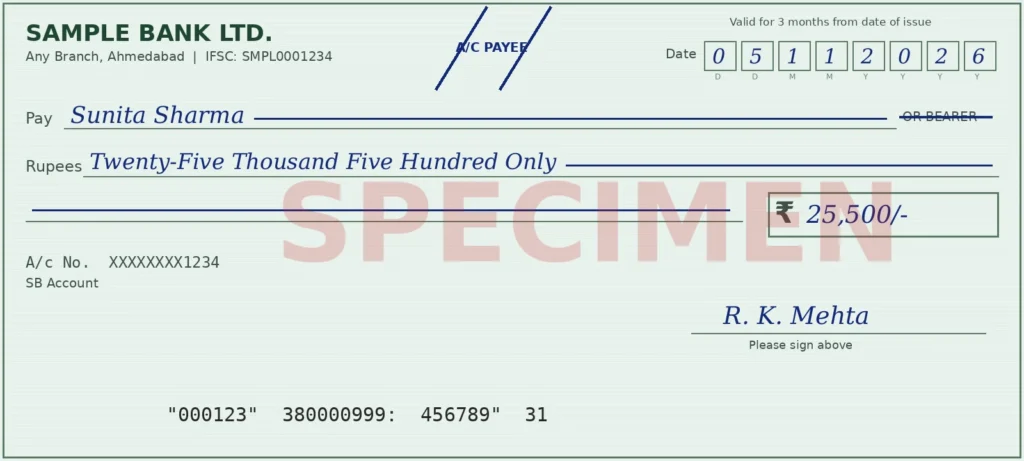
Step 1: Write the date
Write the date in the eight boxes at the top right, one digit per box, in DD MM YYYY format. For 5 November 2026, write 0 5 1 1 2 0 2 6.
- Use the date you are handing over the cheque, unless you mean to issue a post-dated cheque.
- A cheque is valid for three months from the date written on it, as per RBI circular DBOD.AML.BC.No.47/14.01.001/2011-12 dated November 4, 2011, effective April 1, 2012.
- After three months the cheque becomes stale and the bank will not pay it.
Step 2: Write the payee’s name
Write the full name of the person or company you are paying on the “Pay” line, starting as close to the left as possible.
- Match the name to the payee’s bank account. “Sunita Sharma” and “Sunita R. Sharma” can create problems at some banks if the account name is different.
- For a company, write the registered name: “ABC Traders Pvt. Ltd.”, not “ABC”.
- Draw a horizontal line from the end of the name to the end of the line so nothing can be added.
Step 3: Write the amount in words
Write the amount in words on the “Rupees” line and finish with “Only”.
- Example: ₹25,500 becomes “Twenty-Five Thousand Five Hundred Only”.
- Use the Indian numbering system: lakh and crore, not million.
- Strike a line through any space left after “Only”.
For tricky amounts such as ₹1,05,050 or amounts with paise, see our guide on how to write amount in words on a cheque.
Step 4: Write the amount in figures
Write the amount in numbers inside the ₹ box, close to the symbol, and end with “/-“.
- Example: 25,500/-
- Start right after the ₹ sign so no digit can be added in front.
- Use Indian comma placement: 1,25,000/- (not 125,000/-).
- The figure must match the amount in words exactly.
Step 5: Sign the cheque
Sign above “Please sign above” exactly as your signature appears in your bank’s records.
- A mismatched signature is one of the most common reasons for a cheque bounce.
- For a joint account with “Either or Survivor” mode, one holder signs. For “Jointly” mode, all holders sign.
- Never sign a blank cheque.
Step 6: Cross the cheque (if paying another person)
Draw two parallel lines at the top left corner and write “A/C Payee” between them. This makes the cheque payable only into the payee’s bank account, not as cash over the counter.
Crossing is optional but strongly recommended whenever you hand a cheque to someone else. Learn the types in our guide to the crossed cheque.
How to Fill a Cheque for Another Person
To fill a cheque for another person, write their full name as per their bank account on the “Pay” line, strike out “OR BEARER”, and cross the cheque “A/C Payee”. This turns it into an account payee order cheque that can only be deposited into that person’s account.
| Field | What to do for another person |
|---|---|
| Pay line | Payee’s full name, e.g. “Sunita Sharma” |
| “OR BEARER” | Strike it out to make it an order cheque |
| Top left corner | Two parallel lines with “A/C Payee” |
| Amount | Words + “Only”, figures + “/-“ |
| Signature | Yours, as per bank records |
| Back of cheque | Leave blank; the payee writes their details when depositing |
Why strike out “OR BEARER”? A bearer cheque can be paid to whoever presents it at the bank. If it is lost, anyone can try to encash it. Striking out “OR BEARER” makes it an order cheque, which is paid only to the named payee or as per their endorsement. Read the full comparison in bearer cheque vs order cheque.
Cheque for ₹50,000 or more? Register the cheque details on your bank’s Positive Pay System through net banking, mobile app or branch. Under RBI circular DPSS.CO.RPPD.No.309/04.07.005/2020-21 dated September 25, 2020, banks must offer Positive Pay for cheques of ₹50,000 and above and may make it mandatory for ₹5 lakh and above. Several banks now insist on it at ₹50,000, so check your bank’s rule before issuing.
How to Write a Self Cheque
To write a self cheque, write “Self” on the “Pay” line, keep “OR BEARER” as printed, fill in the date and amount, and sign on the front. Do not cross a self cheque, because crossing blocks cash withdrawal.
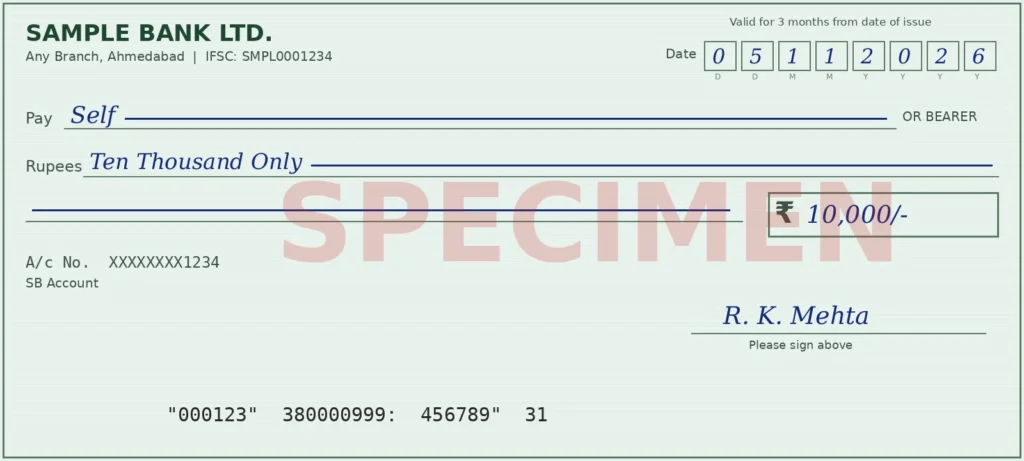
| Field | Self cheque |
|---|---|
| Pay line | “Self” |
| “OR BEARER” | Do not strike out |
| Crossing | None |
| Amount | Words + “Only”, figures + “/-“ |
| Signature | Front, and on the back if the bank counter asks |
Most banks ask you to sign on the back as well when you withdraw cash with a self cheque at the counter. Our detailed guide on the self cheque covers withdrawal limits, home vs non-home branch rules, and whether someone else can collect cash on your behalf.
Self Cheque vs Cheque to Another Person
| Point | Self cheque | Cheque to another person |
|---|---|---|
| Pay line | “Self” | Payee’s full name |
| “OR BEARER” | Keep | Strike out |
| Crossing | No | Yes, “A/C Payee” |
| Purpose | Withdraw cash from own account | Pay someone |
| Money goes to | Your hand, at your bank counter | Payee’s bank account |
| Risk if lost | High, it works like cash | Low, only payee’s account can receive it |
| Positive Pay | Not usually needed | Recommended at ₹50,000 and above |
Sample Filled Cheque Formats (Copy These Patterns)
Use these patterns as a check filling sample for common amounts. Cheque is the Indian spelling; cheque vs check explains the difference.
| Amount | In words | In figures |
|---|---|---|
| ₹500 | Five Hundred Only | 500/- |
| ₹2,750 | Two Thousand Seven Hundred Fifty Only | 2,750/- |
| ₹10,000 | Ten Thousand Only | 10,000/- |
| ₹25,500 | Twenty-Five Thousand Five Hundred Only | 25,500/- |
| ₹1,00,000 | One Lakh Only | 1,00,000/- |
| ₹1,25,450 | One Lakh Twenty-Five Thousand Four Hundred Fifty Only | 1,25,450/- |
| ₹12,50,000 | Twelve Lakh Fifty Thousand Only | 12,50,000/- |
| ₹4,999.50 | Four Thousand Nine Hundred Ninety-Nine and Paise Fifty Only | 4,999.50 |
Parts of a Cheque You Do Not Fill
A cheque has pre-printed fields you leave untouched. Knowing them helps you check that the cheque leaf is yours and genuine.
| Pre-printed field | Location | What it tells you |
|---|---|---|
| Bank name and branch | Top left | Your drawee bank and home branch |
| IFSC code | Below bank name | 11-character branch code for transfers |
| Account number | Middle left | Your account; see where is account number on cheque |
| Cheque number | MICR band, first 6 digits | Unique number of the cheque leaf |
| MICR code | MICR band, next 9 digits | City, bank and branch code |
| Validity note | Top | “Valid for 3 months from date of issue” |
The person who writes the cheque is the drawer, the bank is the drawee, and the person receiving money is the payee. More in drawer, drawee and payee, and the basics in what is a cheque and cheque leaf meaning.
Rules for Correcting a Mistake on a Cheque
You cannot correct the payee name or the amount on a cheque. Only the date can be changed, and that change must be authenticated with your full signature. This comes from RBI circular DPSS.CO.CHD.No.1832/04.07.05/2009-10 dated February 22, 2010, under the CTS-2010 standard, which applies to cheques cleared through the Cheque Truncation System from December 1, 2010.
If you make a mistake:
- Write “CANCELLED” across the cheque between two parallel lines.
- Keep it for your records or destroy it. Do not throw it away intact.
- Write a fresh cheque.
A cancelled cheque is also what banks and employers ask for as account proof. See a cancelled cheque image for the correct format.
Separately, Section 87 of the Negotiable Instruments Act, 1881 makes a materially altered cheque void unless the change was made with the consent of the parties. So even if a bank accepted an altered cheque, it could fail as evidence in a Section 138 cheque bounce case.
Common Mistakes When Writing a Cheque
| Mistake | What happens | How to avoid |
|---|---|---|
| Overwriting the amount | Cheque returned under CTS | Write a fresh cheque |
| Words and figures do not match | Bank returns the cheque | Read both aloud before signing |
| Gap before ₹ figure or after words | Amount can be altered by fraud | Start close to ₹; strike out empty space |
| Signature mismatch | Cheque bounce, bank charges | Sign as per bank records |
| Stale date (over 3 months) | Bank refuses payment | Deposit within validity |
| Payee name spelling error | May be rejected at payee’s bank | Confirm spelling from passbook or app |
| Gel pen or light ink | Image not clear in CTS scan | Use dark ballpoint ink |
| Signing a blank cheque | Open to misuse | Never sign before filling |
| Pinning or stapling the cheque | Damages MICR band | Use a paper clip or envelope |
| No Positive Pay on large cheque | May be held or returned | Register details for ₹50,000 and above |
Safety Tips Before You Hand Over a Cheque
- Note the cheque number, date, payee and amount in the counterfoil or your phone.
- Keep your cheque book locked away; report a lost cheque book to your bank immediately and request stop payment.
- Do not write your PAN, mobile number or any other detail on the front.
- Make sure your account has enough balance; a bounced cheque attracts bank charges and possible legal action.
- For cheques of ₹50,000 and above, register Positive Pay at least a day before the payee deposits it.
What Happens After You Give the Cheque
The payee deposits the cheque at their bank branch, cheque drop box or CTS kiosk using a deposit slip. Our guides on how to deposit a cheque and how to fill a deposit slip walk through that side. The time it takes for money to reach the payee is covered in cheque clearing time.
What Experts Say
Bank branch staff consistently point to two errors behind most returned cheques: a signature that does not match bank records, and an amount in figures that has been overwritten. Practitioners advise treating any cheque with a correction as already cancelled. For business payments, accountants recommend always crossing “A/C Payee” and registering Positive Pay for high-value cheques, since it gives the drawer access to RBI’s dispute resolution mechanism if something goes wrong.
Frequently Asked Questions
Can I write a cheque with a black pen?
Yes. RBI advises dark ink so the cheque image scans clearly under CTS. Blue or black ballpoint both work. Avoid gel pens that smudge, light colours, and pencil.
What happens if the amount in words and figures do not match?
Section 18 of the Negotiable Instruments Act, 1881 says the amount in words prevails. In practice, most banks return such cheques under CTS, so write a fresh cheque instead.
Can I correct a mistake on a cheque by signing next to it?
Only the date can be corrected, and the change must be authenticated with your full signature. Any correction to the payee name or amount means the cheque will be returned. Cancel it and write a new one.
How long is a cheque valid in India?
A cheque is valid for three months from the date written on it, as per RBI rules effective April 1, 2012. After that it becomes stale and the bank will not pay it.
Can I leave the payee name blank?
You can, but you should not. A cheque with a blank payee line can be filled in by anyone who gets hold of it. Always write the name before handing it over.
Do I need to write my account number on the cheque?
No. Personalised cheques already carry your account number. When depositing a cheque from someone else, banks often ask you to write your own account number and mobile number on the back.
Is it check or cheque in India?
Cheque is the British and Indian spelling. Check is the American spelling. Indian banks, RBI and the Negotiable Instruments Act all use cheque.
Sources: RBI circular DPSS.CO.CHD.No.1832/04.07.05/2009-10 (February 22, 2010) on CTS-2010 standard; RBI circular DBOD.AML.BC.No.47/14.01.001/2011-12 (November 4, 2011) on cheque validity; RBI circular DPSS.CO.RPPD.No.309/04.07.005/2020-21 (September 25, 2020) on Positive Pay System; Negotiable Instruments Act, 1881, Sections 18 and 87. Sample cheques shown are fictional and for illustration only. Bank-specific rules on Positive Pay thresholds and cash withdrawal may differ; confirm with your bank.